The decision in brief
Define the user and intended use before comparing devices. Keep company statements, historical reporting and prototype research separate; request evidence for the exact model and destination market.
A walking exoskeleton can look convincing in a short demonstration. The harder purchasing decision comes afterwards: who is supposed to wear it, what must that person already be able to do, and what has actually been tested?
China’s public product material spans clinical rehabilitation, everyday assistance and outdoor use. Similar-looking hardware can therefore lead to very different procurement decisions. This note separates those use cases and the evidence behind them. It is an exploratory category study, not a qualified-supplier list or an expansion into clinical assessment services.
Three use cases, different evidence questions
These are buyer-facing distinctions, not three legal classifications. Everyday walking and outdoor recreation can overlap; the exact intended use matters more than the category label.
Clinical rehabilitation. Start with the proposed therapeutic purpose, eligible users, setting and supervision. In the United States, 21 CFR 890.3480 defines a prescription powered lower-extremity exoskeleton for medical purposes and places that category in Class II with special controls. It does not establish that a named Chinese product is cleared for sale or that every consumer wearable belongs in that category. Source 1
Everyday walking assistance. A product may be offered to assist a movement without a treatment claim. Ask whether users must already stand, walk and balance independently. Reduced effort, independent mobility and fall prevention are different outcomes; evidence for one should not be substituted for another.
Outdoor use. Hypershell’s X-series page positions the product as nonmedical and says it requires unassisted walking and balance. That manufacturer statement helps identify its proposed user; it is not a clinical assessment or a regulatory opinion. A successful hiking demonstration would not establish suitability for someone with substantial mobility impairment. Source 2
For a distributor, these distinctions affect fitting, instructions, training, support and the claims that can responsibly be made to customers.
What the Chinese examples establish
RoboCT’s company timeline says it launched the GoGo series in 2025, following earlier rehabilitation-oriented development. Treat that as company history, not independently verified clinical performance. Its public marketing is a starting point for a model-specific document request. Source 3
A separate Xinhua report, dated 18 March 2025, described a RoboCT battery-free walking-assistance design ahead of launch. The supplied SCIO link is a republication dated the following day. We use the accessible Xinhua original. Do not assume that the historical passive design and a currently advertised powered model are interchangeable, or that an old launch price is a current quotation. Source 4
Hangzhou’s information portal reported on the AsExo-TK1000 “Tashan” on 8 January 2026, identifying its developer as China South Industries Group Corporation’s Zhiyuan Research Institute in Hangzhou. The report describes hip and waist support. Its performance and price statements remain reported product claims; we have not obtained the underlying tests or current commercial documentation. Source 5
On 13 January 2026, the State Council’s English website reported guidelines that explicitly mention exoskeletons and muscle suits for older people with declining physical function. That establishes policy interest. It does not establish sales, routine use or suitability for a particular buyer. Source 6
Read the research at the right level
A July 2026 feasibility study enrolled ten older adults. Its prototype produced 1.8 more one-minute sit-to-stand repetitions on average; walking metabolic analysis in nine participants reported a 13.6% mean reduction. The comparison was assistance on versus off while wearing the suit, not against wearing no device. Source 7
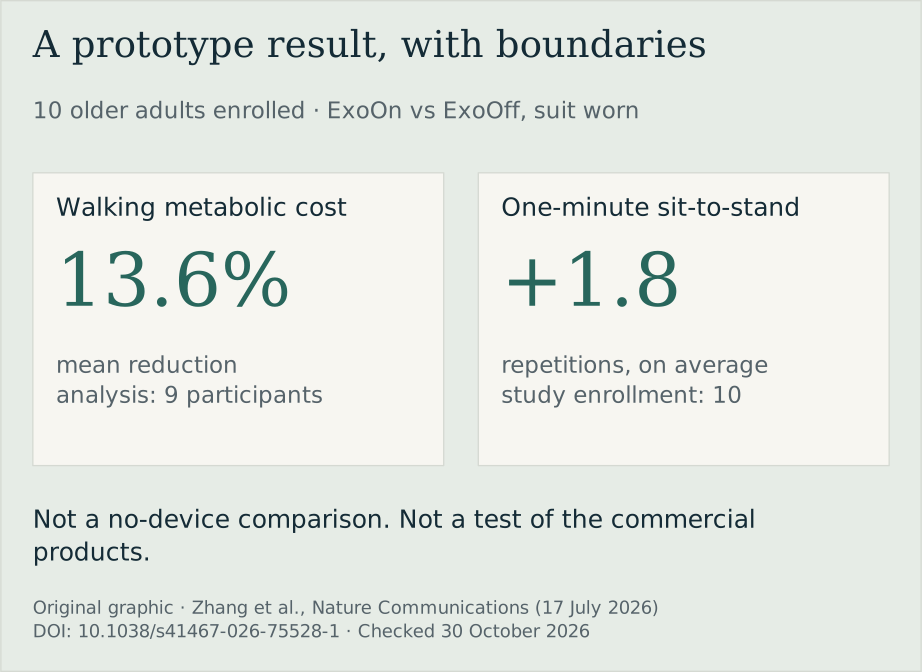
These are short-term, task-specific results. They do not show that the Chinese products discussed here deliver the same effects, or establish fewer falls, lower care costs or long-term independent living. A device that helps during a supervised task also raises a separate question: does any improvement persist after it is removed?
A 2026 knee-exoskeleton systematic review highlights heterogeneous devices, limited clinical samples and uncertain lasting rehabilitation gains. Its findings should not be transferred wholesale to hip-assistance products. Source 8
Five questions for an international buyer
Use a written evidence request before comparing quotations. Keep the legal entity, exact model, configuration, source and check date alongside each answer.
| Buyer question | Useful evidence request |
|---|---|
| Who can use it? | Intended use, inclusion/exclusion criteria, independent balance requirements, fitting limits and required supervision. |
| What movement is assisted? | Hip, knee or ankle; powered or passive mechanism; supported tasks, restrictions and the exact model revision. |
| What supports the claim? | Protocol, participant characteristics, analyzed sample, comparator, outcome definition, adverse-event reporting and limitations. |
| What happens during interruption? | Documented behavior at low battery, loss of power or unexpected stopping; removal/release arrangements, warnings and training. |
| Who supports it locally? | Destination-specific intended-use documents, qualified regulatory review, fitting, repair responsibility, spare parts and warranty terms. |
The interruption questions need to match the mechanism: a passive device has no low-battery mode, but its removal, mechanical behavior and use restrictions still need investigation. Do not perform unsupervised safety experiments on a person to fill an evidence gap.
Download the editable exoskeleton buyer-question worksheet (CSV). It records answers and unresolved issues; completing it is not product approval. For a general evidence method, read Supplier Claims vs. Verified Evidence.
A sourcing opportunity still needs a service model
Lighter, more specific assistance could create useful product propositions. That remains a business hypothesis until a buyer can establish a suitable user group, supportable claims, workable distribution economics and reliable local service.
A compelling demonstration does not answer questions about prolonged comfort, fit across body types, returns, maintenance or total ownership cost. Assess the service obligations around the device as carefully as the hardware. At this stage, a clear unresolved question is more useful than a premature “verified” label.
Research approach and limits
Checked on 30 October 2026 using public product pages, original reporting, current regulatory text and accessible research. Publisher-indexed Nature text was available through search, while direct retrieval redirected to its identity service. Social-video metadata informed the lead register only: none of the six supplied clips was visually verified or included as evidence of performance. We have not tested products, audited factories or verified product-specific market authorization. This is industry research, not medical advice or a product endorsement.
Sources & scope
Sources support the specific factual statements cited. The comparison frameworks and suggested buyer actions are Origin & Signal's editorial analysis.
[1] eCFR / Office of the Federal Register · 21 CFR 890.3480 — Powered lower extremity exoskeleton
Published: Current text; Title 21 up to date to 27 October 2026 · Checked: 2026-10-30B for the defined US medical-device category and Class II special controls. Not an approval or classification of any product named here. Replaces the input FDA ID=4210 link, whose live record conflicted with its search-index description.
[2] Hypershell · Hypershell X Series — intended-use notice
Published: Undated live product page · Checked: 2026-10-30C for the manufacturer’s nonmedical positioning and requirement for unassisted walking and balance. Not independent safety evidence or a legal determination.
[3] RoboCT · About RoboCT — company timeline
Published: Undated live company page; timeline includes 2025 · Checked: 2026-10-30C for the company’s own history and GoGo-series launch statement. No independent clinical-validation, approval, customer-count or manufacturing-capacity claim is adopted.
[4] Xinhua · Economic Watch: Cyborg-like walking assistance device targets China’s expanding elderly market
Published: 18 March 2025 · Checked: 2026-10-30B for the existence/date of the report; C for its attributed product design and prelaunch claims. This is historical reporting, not a current offer or a confirmed identity match to GoGo-H Pro. SCIO’s 19 March republication timed out; the original Xinhua page was retrieved.
[5] Hangzhou city information portal · Hangzhou-made exoskeleton named among China’s top innovations
Published: 8 January 2026 · Checked: 2026-10-30B for the publication and reported developer; C for embedded product-performance and price claims. No independent test report or current destination-market authorization was established.
[6] State Council English website / Xinhua · China to promote tech-enabled elderly care to enhance seniors’ well-being
Published: 13 January 2026 · Checked: 2026-10-30B for reporting of policy interest in exoskeletons and muscle suits. Not sales, adoption, reimbursement or medical-effectiveness evidence.
[7] Zhang et al., Nature Communications 17, 6540 · Enhancing sit-to-stand transitions and walking efficiency in older adults with a soft robotic suit
Published: 17 July 2026 · Checked: 2026-10-30A only for this prototype and experimental sample: 10 enrolled, walking metabolic results in 9; ExoOn versus ExoOff while wearing the suit. Publisher-indexed full text including methods/discussion was retrieved through search; direct page fetch redirected to Nature’s identity service. No commercial Chinese model was tested by this evidence.
[8] JMIR Rehabilitation and Assistive Technologies · State-of-the-Art Knee Exoskeleton for Gait Assistance and Rehabilitation: Systematic Review
Published: 4 August 2026 · Checked: 2026-10-30A for this review’s synthesis, with heterogeneity, small/healthy samples, short interventions and uncertain durable rehabilitation gains. Not a pooled effect size, supplier comparison or validation of hip devices.
Corrections: use our contact page. See the research disclaimer before relying on this note.